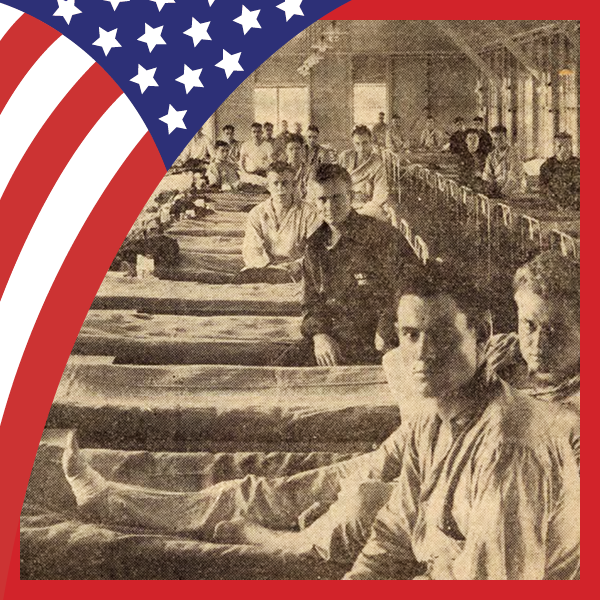
During World War I and again in World War II, Baltimore medical schools and teaching hospitals were recruited by the Army to organize cohesive medical units that could care for wounded soldiers.
This story is one in a series about the University of Maryland, Baltimore’s (UMB) contributions to U.S. history as the nation celebrates its 250th birthday this year. The stories will be featured on The Elm website/Elm Weekly newsletter in the coming months. The series can be read at the UMB Celebrates America at 250 website. The July episode of “The UMB Pulse” podcast features a discussion about UMB history with Tara Wink of the Health Sciences and Human Services Library.
When Americans think about the World Wars, they often picture soldiers climbing into trenches, storming beaches, or flying across hostile skies. The hospitals that waited behind the front lines are far less visible.
Every wounded soldier who survived because of a skilled surgeon, every infection prevented by a vigilant nurse, every shattered jaw reconstructed by a dentist, every dose of medicine carefully prepared by a pharmacist depended on another kind of military unit — one armed not with rifles, but with knowledge.
During World War I and World War II, the University of Maryland, Baltimore (UMB) helped build those units. It wasn’t simply a handful of volunteers leaving the University for military service. It was something far more ambitious. It was an entire hospital.
Building Fully Functioning Medical Units in World War I
As the United States entered World War I in 1917, the Army faced an enormous challenge. It needed complete hospitals that could be assembled quickly and deployed overseas.
Rather than recruiting individual physicians and nurses one by one, military leaders turned to the nation’s leading medical schools and teaching hospitals, asking them to organize fully functioning medical units that could care for thousands of wounded soldiers almost immediately.
Baltimore answered the call.
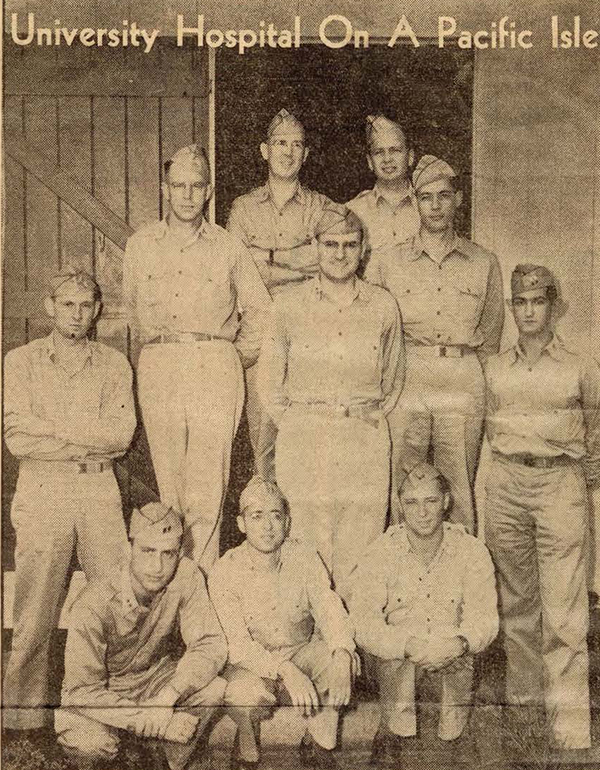
This photo shows several of the doctors and medical professionals from Baltimore who staffed General Hospital No. 42 during World War II. The photo was published in Baltimore’s Evening Sun on Nov. 24, 1943, and taken from a PDF of a scrapbook located in the UMB Digital Archive.
UMB and Johns Hopkins combined their expertise to create Base Hospital No. 42, the 42nd medical unit of its kind formed by the Army, which was operated by physicians, surgeons, nurses, dentists, and other health professionals drawn from both institutions. The School of Nursing at UMB mobilized 30 graduates through the American Red Cross to help staff the unit, and the entire hospital consisted of about 100 nurses, 35 medical officers, and 200 enlisted men. They had trained together, practiced together, and taught together. Now they would go to war together.
What crossed the Atlantic Ocean was more than people, it was an academic medical center.
The operating rooms, laboratories, nursing services, pharmacy operations, dental care, and administrative systems that had been refined in Baltimore were re-created overseas to care for American soldiers. In many ways, the unit represented one of the earliest examples of truly integrated team-based health care deployed on a global stage.
Extraordinary Teamwork
The unit deployed to Bazoilles-sur-Meuse, France, where the hospital opened in July 1918. The work was unrelenting, the teamwork unwavering.
Physicians treated devastating injuries caused by artillery, machine guns, and poison gas. Surgeons performed complex operations under conditions that were often primitive by modern standards. Nurses worked exhausting shifts, providing not only care but also comfort to young men far from home. Dentists reconstructed faces damaged by combat, helping soldiers regain the ability to eat, speak, and, in many cases, reclaim a sense of identity.
The unit operating during what was dubbed the Great War would treat more than 8,000 wounded and ill soldiers before being disbanded, but every member of the hospital learned that healing required more than a single profession. It required a team.
That philosophy had long been part of life in Baltimore, where physicians, nurses, dentists, pharmacists, and scientists worked alongside one another in the service of patients. War simply transported that model across an ocean.
A generation later, history repeated itself during World War II.
When the United States entered the war, the University of Maryland again helped organize a complete military hospital. This time it was General Hospital No. 42, another fully staffed medical unit that carried Baltimore’s collaborative approach to patient care into history’s biggest and deadliest conflict. Faculty, alumni, students, and clinicians again left classrooms, clinics, and laboratories to serve wherever the U.S. military needed them most.
By then, medicine had changed dramatically. Blood transfusions had become more sophisticated. New surgical techniques improved survival rates. Sulfa drugs and, later, penicillin transformed the treatment of infection. Yet one principle remained unchanged: Extraordinary health care depended upon extraordinary teamwork.
The hospitals organized by the University of Maryland during both World War I and World War II reflected that belief.
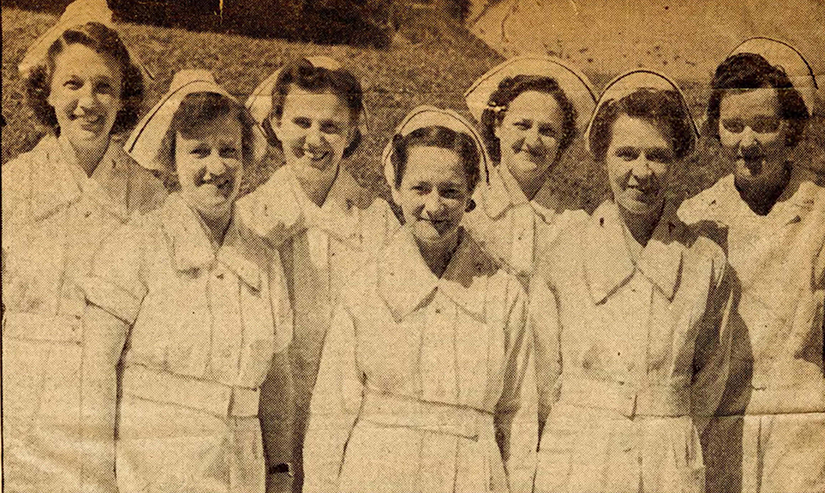
Nurses recruited almost entirely from Baltimore hospitals staffed General Hospital No. 42 to help treat military personnel who were injured in the Pacific Theatre during World War II. This photo was used in Baltimore’s Evening Sun on Nov. 1, 1943, and taken from a PDF of a scrapbook located in the UMB Digital Archive.
A Shared Commitment to Healing
Long before the phrase “interprofessional education” entered the vocabulary of modern health care, these military hospitals demonstrated what it looked like in practice. Physicians depended on nurses. Surgeons relied on anesthetists and pharmacists. Dentists restored function after devastating injuries. Laboratory personnel provided the information that guided treatment. Every discipline mattered because every patient mattered.
The experience also reshaped American medicine once the wars ended.
After both wars, thousands of military clinicians returned home with new surgical techniques, new approaches to trauma care, and a deeper appreciation for coordinated medical practice. Lessons learned in military hospitals found their way into civilian hospitals across the country, helping improve emergency medicine, rehabilitation, infection control, and hospital organization for generations of Americans.
As the United States celebrates its 250th birthday this year, the stories of Base Hospital No. 42 during World War I and General Hospital No. 42 during World War II remind us that patriotism is not always demonstrated on the battlefield.
Sometimes it is measured in operating rooms.
Sometimes it is measured by the steady hands of a nurse comforting a frightened patient, by the pharmacist preparing lifesaving medications, by the dentist restoring a soldier’s ability to smile, or by the physician refusing to give up on a life that others believed could not be saved.
UMB did not simply send individuals to war, it also sent the very best of what an American university could be, a community of health professionals united by knowledge, compassion, and a shared commitment to healing.
More than a century later, that spirit remains at the heart of UMB. The professions have grown, the technologies have changed, and our University has expanded, but the idea is the same as it was when Hospital No. 42 first sailed from Baltimore.
The strongest teams save the most lives.