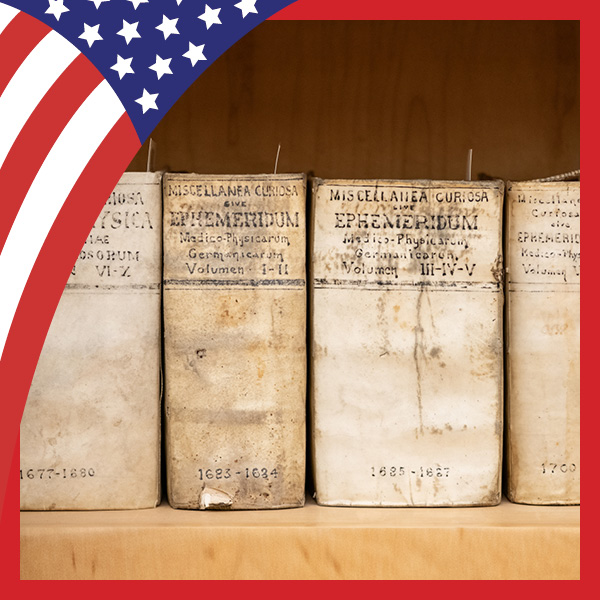
A $500 investment in Dr. John Crawford’s collection of medical books grew into a library that has been instrumental in shaping the education of generations of health and human services professionals.
This story is one in a series about the University of Maryland, Baltimore’s (UMB) contributions to U.S. history as the nation celebrates its 250th birthday this year. The stories will be featured on The Elm website/Elm Weekly newsletter in the coming months. The series can be read at the UMB Celebrates America at 250 website. The July episode of “The UMB Pulse” podcast features a discussion about UMB history with Tara Wink of the Health Sciences and Human Services Library.
In 1813, as a the War of 1812, a quiet but remarkable event unfolded in Baltimore. There were no crowds gathered to witness it and no newspaper headlines proclaiming its significance. Instead, a physician named John Crawford’s personal collection of medical books was acquired for $500 by the newly established University of Maryland School of Medicine (UMSOM), which was originally named the College of Medicine of Maryland.
At the time, it might have seemed like a modest collection — a few hundred volumes carefully assembled over the course of a career. In reality, it was the beginning of something much larger. Those books became the foundation of the University of Maryland, Baltimore’s (UMB) Health Sciences and Human Services Library (HSHSL), one of the oldest medical libraries in the United States and an institution that has spent more than two centuries helping shape the education of physicians, nurses, dentists, pharmacists, researchers, and other health professionals.
America has always celebrated its inventors and pioneers. We remember those who discovered vaccines, developed lifesaving surgical techniques, or unlocked the mysteries of disease. Yet behind every breakthrough is another story that receives far less attention. Every generation of scientists builds upon the work of those who came before. That chain of discovery is only possible if knowledge is preserved, organized, and shared.
That is the story of HSHSL.
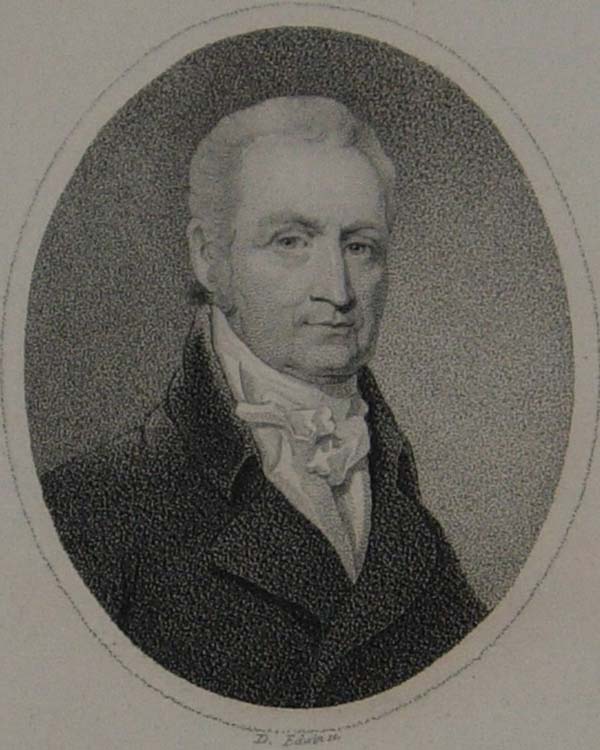
Dr. John Crawford's collection of medical books was bought by the University of Maryland School of Medicine.
UMSOM was founded in 1807 as the nation’s first public medical school and the fifth oldest in the country. It was established during a period when American medicine was still finding its footing. Physicians often trained through apprenticeships, medical textbooks were scarce, and much of the world’s medical knowledge remained scattered across Europe in expensive volumes that were difficult to obtain.
For students arriving in Baltimore, access to books was almost as valuable as access to professors.
Dr. Crawford understood that. A former British naval surgeon who had made Baltimore his home, he thought that physicians should learn not only from patients and teachers but also from the accumulated wisdom of generations. His personal library reflected the best medical thinking of its day and was thought to be the largest medical library in Baltimore at the time of his death in1813.
Historians think the collection may have formed one of the nation’s earliest libraries established specifically to support a medical school. While it is difficult to say with certainty that it was the first, there is little doubt that it is among the oldest. More importantly, it reflected an idea that would become central to U.S. medical education: learning should not end with a diploma. Every physician has an obligation to continue studying, questioning, and building upon what others have learned.
Filling the Shelves
As medicine advanced throughout the 19th century, so did the library. Shelves that once held one physician’s collection gradually expanded into thousands of books, journals, anatomical atlases, scientific reports, photographs, and rare manuscripts documenting the rapid transformation of health care. Students studying in Davidge Hall could move between anatomy demonstrations and the library, connecting what they observed in the laboratory with discoveries being published around the world.
The library became more than a repository of books. It became part of the educational process itself.
The pace of medical discovery accelerated dramatically over the next two centuries. The emergence of anesthesia transformed surgery from an agonizing last resort into a sophisticated discipline. Germ theory revolutionized the understanding of infection. Antibiotics, vaccines, medical imaging, genetics, transplantation, and countless other advances reshaped nearly every aspect of patient care. Through each of these revolutions, HSHSL served as both witness and participant, ensuring that new discoveries reached the students, clinicians, and researchers who would carry them into practice.
Today, the library looks very different than it did in 1813. Digital databases have replaced countless card catalogs. Researchers can access journals from around the globe in seconds rather than waiting weeks for printed volumes to arrive by mail. Students collaborate in technology-rich learning spaces unimaginable to Crawford’s generation.
Yet the mission remains remarkably familiar.
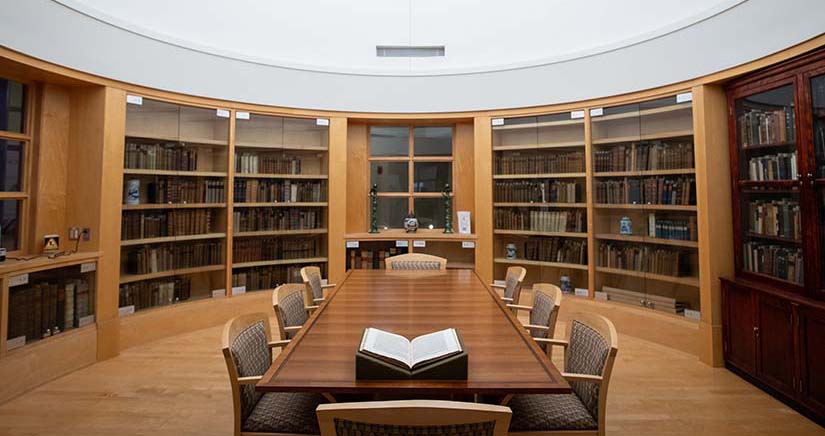
The Historical Collections Department is located on the fifth floor of the Health Sciences and Human Services Library.
Collecting History
HSHSL continues to connect people with the knowledge they need to improve health and advance science. Whether preserving rare 19th-century anatomy texts, supporting groundbreaking biomedical research, or helping students navigate the latest clinical evidence, the library serves as the intellectual heart of an academic health center dedicated to discovery.
Perhaps nowhere is that continuity more evident than in the library’s Historical Collections Department. Crawford’s original books remain carefully preserved alongside thousands of other rare volumes that chronicle the history of medicine. Their worn leather bindings and handwritten notes remind visitors that every generation inherits knowledge from those who came before. What seems commonplace today was once revolutionary. What future physicians discover will, in turn, rest upon the foundations laid by today’s scholars.
As the United States celebrates the 250th anniversary of the Declaration of Independence this year, the story of HSHSL reminds us that America’s progress has depended not only on those who made history, but also on those who preserved it. Long before search engines and digital archives, librarians carefully collected ideas, protected fragile manuscripts, and ensured that knowledge could pass from one generation to the next.
The library’s greatest contribution cannot be measured simply by the number of books on its shelves or journals in its databases. It can be seen instead in every physician who made a better diagnosis because of something he or she read, every scientist whose research built upon an earlier discovery, every student whose curiosity was sparked by an old volume, and every patient whose life was improved because knowledge was never allowed to disappear.
More than two centuries after Crawford unpacked his books in Baltimore, HSHSL continues to prove that some of history’s most powerful gifts are not inventions themselves, but the places that ensure that those inventions — and the knowledge behind them — endure.