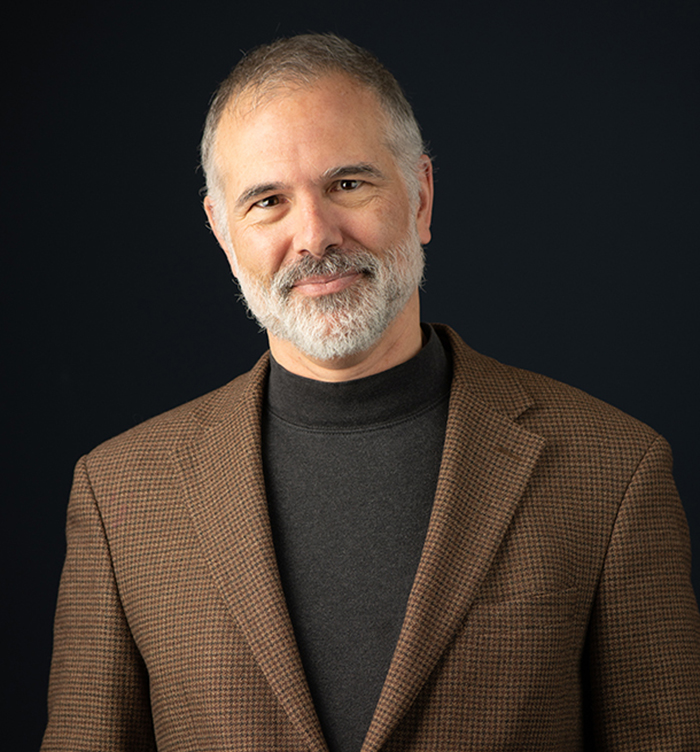
The University System of Maryland recognizes the School of Social Work professor with its prestigious annual honor for excellence in research/scholarship.
Four faculty members from the University of Maryland, Baltimore (UMB) have been recognized with University System of Maryland (USM) Board of Regents Faculty Awards, the highest honor presented by the board to exemplary faculty members within the 12-institution USM. The UMB awardees are Eric Strauch, MD, School of Medicine; Sara Gold, JD, and Maxwell Stearns, JD, Francis King Carey School of Law; and Jay Unick, PhD, MSW, School of Social Work. (Additionally, two UMB employees were honored with Board of Regents Staff Awards.)
USM faculty members are honored annually for their excellence in one of five categories: Teaching; Scholarship or Research; Creative Activity; Public Service; or Mentoring. Each UMB winner is being profiled on “The Elm.”
Today: Jay Unick, PhD, MSW, Professor, School of Social Work; Excellence in Scholarship or Research
About Dr. Unick
Jay Unick is well known for his work in advancing research and practice across organizations that serve individuals with severe mental illness and those recovering from substance use disorders.
He has demonstrated excellence in leading rigorous, community-based behavioral health research that drives meaningful change. Dr. Unick applies advanced quantitative and qualitative methods, clinical trials, and modern observational designs to strengthen systems of care for individuals with serious mental illness and substance use disorders.
His work centers on developing and testing interventions such as telehealth that improve medication adherence in community mental health settings and recovery service models that reduce emergency care use and support long-term recovery from opioid use disorder. Through multiple National Institutes of Health (NIH)- and Department of Justice-funded projects, he has built strong partnerships among researchers, providers, and communities to translate evidence into policy and practice, advancing behavioral health equity and improving outcomes for vulnerable populations.
Additionally, Dr. Unick collaborated with leading recovery researchers nationwide to establish the National Institute on Drug Abuse-funded Consortium on Addiction Recovery Science. The initiative advances recovery science by standardizing measurement, connecting researchers with community providers, and mentoring the next generation of investigators, including creating pathways for individuals with lived experience of substance use to engage in research.
Dr. Unick has been recognized as a fellow of the Society for Social Work and Research, served on multiple NIH review committees, and was an editor for The Journal of Recovery Science, established in 2018 as the first academic journal specifically dedicated to the study of recovery from substance use and mental health disorders.
Kudos from Colleagues
“Dr. Unick’s research contributions are deep and broad: more than 85 peer-reviewed publications, a funding portfolio surpassing $25 million, and an international reputation for methodological innovation and community-engaged scholarship. His work has not only advanced the science of behavioral health and substance use research, it also has saved lives.
“His influence is also evident in his role as mentor and educator. He has chaired or served on more than 20 doctoral dissertation committees at the School of Social Work, directly shaping the next generation of behavioral health researchers. Many of his mentees have gone on to academic appointments or leadership roles in practice and policy, amplifying his scholarly impact.”
— Judy L. Postmus, PhD, ACSW, Dean and Professor, University of Maryland School of Social Work
“I work in injury control and drug epidemiology, and I first came across Jay’s work in the literature. It was immediately clear he wasn’t just another data jockey. Rather, he’s the rare kind of scientist who actually understands the human and structural realities behind the numbers.
“There is nobody I trust more than Jay when it comes to measurement, coding, and the messy but critical business of interpreting International Classification of Diseases-10 data. He also writes beautifully — like a social scientist in a public health world with soul. He writes with precision, is grounded, and provides deeply contextual intel in all of his work.”
— Lori Ann Post, PhD, MA, Professor of Emergency Medicine and Medical Social Sciences, Northwestern University Feinberg School of Medicine
“Dr. Unick is a highly regarded and productive scholar in my field as well as behavioral health related to addiction. Working at the intersection of public health, social work, and addiction, his initiatives, both as a scholar and an advocate, have had a profound impact on recovery-oriented systems of care.
“He and I have co-authored 11 publications. All are of note, but one especially: Jay first-authored a paper, early in the opioid crisis, on the ‘intertwined epidemics’ of overdose due to prescription opioids in relation to rising overdoses due to illicit heroin. This paper was recognized all the way to the White House, the title became lingua franca in describing the evolving epidemic, and our collaborative work on defining the opioid crisis has garnered intense media attention.”
— Dan Ciccarone, MD, MPH, Professor of Family and Community Medicine, University of California, San Francisco School of Medicine
Dr. Unick Says …
What was your reaction to winning the USM award?
“It is always nice to get awards, and I am very grateful for the recognition from my peers and from the University System of Maryland. It is a tremendous honor. What made it especially meaningful was hearing from so many colleagues and collaborators. It gave me the chance to reconnect with people I had not spoken with in some time, and it was a wonderful reminder of the strong and supportive community we have at UMB.”
How does it feel to be selected among thousands of faculty members within USM?
“It is very humbling because there are so many talented faculty members across the system. I am constantly struck by the extraordinary work being done by colleagues throughout USM. But none of my work happens in isolation, so this recognition also feels like a reflection of the quality collaborations and partnerships that make it possible. The issues we are trying to address, including opioid overdose and other major social challenges, demand multiple disciplines and perspectives working together.”
What project, initiative, research, or accomplishment are you most proud of during your time at UMB?
“One of the accomplishments is our Innovations in Recovery through Infrastructure Support [IRIS] project. It has brought together a community of providers, researchers, and individuals with lived experience, and through that work I have gained a much deeper understanding of recovery and recovery systems from multiple perspectives.
“What has made this project especially meaningful is not only the research itself, but the way it has created space for people with lived experience to see themselves as partners in the research process. One of my proudest moments was hearing a participant say during a joint presentation that, before IRIS, she never felt research was for people like her, but that the project had empowered her to develop research ideas and help answer questions that matter to her community.”
What is your greatest asset as a researcher?
“One of my greatest assets is my ability to create space for multiple perspectives to be heard, considered, and productively explored within a research team. I have been fortunate to work with people who are dedicated, thoughtful, hardworking, and deeply committed to addressing urgent social issues. My role is often to help create the conditions for that kind of team to thrive, offering guidance and direction while also giving others the room to contribute their ideas and strengths. I see that ability to support strong collaboration with a light touch as one of my greatest strengths.”