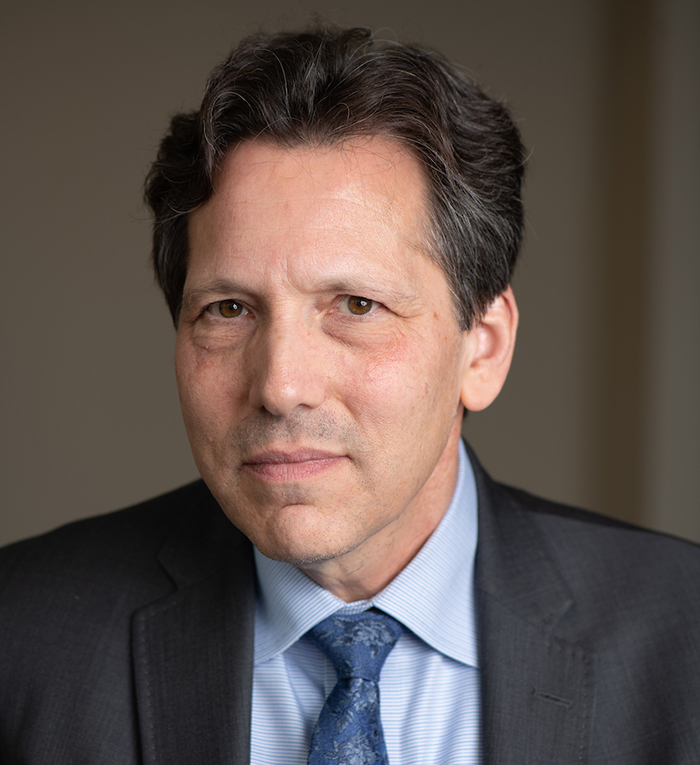
The University System of Maryland recognizes the Francis King Carey School of Law professor with its prestigious annual honor for excellence in scholarship/research.
Four faculty members from the University of Maryland, Baltimore (UMB) have been recognized with University System of Maryland (USM) Board of Regents Faculty Awards, the highest honor presented by the board to exemplary faculty members within the 12-institution USM. The UMB awardees are Eric Strauch, MD, School of Medicine; Sara Gold, JD, and Maxwell Stearns, JD, Francis King Carey School of Law; and Jay Unick, PhD, MSW, School of Social Work. (Additionally, two UMB employees were honored with Board of Regents Staff Awards.)
USM faculty members are honored annually for their excellence in one of five categories: Teaching; Scholarship or Research; Creative Activity; Public Service; or Mentoring. Each UMB winner is being profiled on “The Elm.”
Today: Max Stearns, JD, Venable, Baetjer & Howard Professor of Law, Francis King Carey School of Law; Excellence in Scholarship or Research
About Professor Stearns
Maxwell Stearns is recognized for his expertise in drawing upon principles of economic theory, broadly understood, to address vital questions concerning the state of democracy in the United States and in offering practically grounded solutions. His work applies economic analysis, including social choice and game theory, to constitutional law and institutional decision-making, offering robust insight into often-confounding doctrine.
Witnessing the state of U.S. democracy and the dearth of practical solutions, Professor Stearns has dedicated himself to diagnosing the root causes and offering a pathway forward. His 2024 book, “Parliamentary America: The Least Radical Means of Radically Repairing Our Broken Democracy,” couples analytical clarity with a structurally grounded remedy. It has not only earned praise among leading democracy experts, it also has enabled Professor Stearns to engage broader public audiences with speeches, radio interviews, podcasts, and more.
His work demonstrates that the country’s most vital systems, including education, health care, and law, and our capacity to address pressing public policy challenges critically depend on robust democratic institutions.
Professor Stearns also created and runs Maryland Carey Law’s Virtual Constitutional Law and Economics Workshop, bringing together leading interdisciplinary scholars from across the United States and abroad. He teaches Constitutional Law I and II (Governance and Individual Rights, respectively) and Law and Economics, and served as Maryland Carey Law’s associate dean for research and faculty development from 2013-17.
Kudos from Colleagues
“Since 2017, Professor Stearns has turned his attention to the crisis facing American democracy. Through his blog, blindspotblog.us, and his book, ‘Parliamentary America,’ he has analyzed the forces causing this crisis, outlined why many popular proposals fail to address those forces, and put forth an ambitious plan for restructuring the electoral system and the composition of Congress.
“In addition to his scholarship and teaching, Professor Stearns fosters scholarly community. He is a regular participant in internal faculty scholarship workshops and a frequent contributor during presentations by visiting scholars. He is a generous, accomplished, and visionary scholar who is tackling the existential questions we face as a nation.”
— Renée Laurent, JD, Dean and Professor of Law, Maryland Carey Law
“Professor Stearns’ work has had a considerable impact on legal scholarship. My favorite article in his extensive body of work is his 2003 William & Mary Law Review article evaluating dormant commerce clause doctrine in terms of game theory. Max brought a convincing coherence to this notorious, even infuriating body of law enabling courts to review state and local laws that either regulate or tax interstate commerce.
“In a painfully divided society and legal academy where ideological divisions are often — and regrettably — both deep and harsh, Professor Stearns stands out as a thorough, thoughtful scholar who defies ideological categorization.”
— James M. Chen, JD, MS, MA, Professor of Law and Justin Smith Morrill Chair in Law, Michigan State University College of Law
“I met Professor Stearns when I first joined the legal academy as a visiting professor at Maryland Carey Law, and Max was a faithful and kind supporter and mentor from the start. He welcomed me into the law school’s community with great warmth and helped me see myself as an academic. There was nothing that he would not do to help, and he was like that with every junior — and more seasoned — academic.”
— Danielle Keats Citron, JD, Jefferson Scholars Foundation Schenck Distinguished Professor in Law, University of Virginia School of Law
Professor Stearns Says …
What was your reaction to winning the USM award?
“I was deeply honored and very appreciative. This recognition reflects not just a single moment, but years of sustained work, and it’s gratifying to see that effort acknowledged. I’m also grateful that over several decades, colleagues and interlocutors have enriched my understanding of law, political science, economic theory, and other disciplines in ways that have had a profound impact on my scholarship.”
How does it feel to be selected among thousands of faculty members within USM?
“This recognition is both humbling and affirming. The work being done across disciplines in USM is so rich and varied that it can’t really be compared. What makes this award so meaningful to me is less about how my work compares with that of others than how it stands at this moment of genuine crisis for our democracy. My work is dedicated to ensuring an incisive understanding of why our political and legal institutions are failing us, and to envisioning a viable, if radical, pathway forward that can ensure their success for ourselves and for future generations.”
What project, research, or accomplishment are you most proud of during your time at UMB?
“I am most proud of my book, ‘Parliamentary America: The Least Radical Means of Radically Repairing Our Broken Democracy.’ This book reflects a through-line that has marked my decades-long academic career.
“For most of my career, I focused on developing a more complete understanding of the functions that constitutionally established institutions and legal doctrines — often widely misunderstood and heavily criticized — ultimately serve. That decades-long project motivated me to gain expertise well beyond law, drawing upon tools from economics, game theory, and social choice. These tools allowed me to identify vital features of institutional structures and doctrines widely overlooked among analysts who instead proceed by identifying perceived problems and then proposing often bold reforms without having fully examined what existing institutional arrangements are accomplishing.
“My project of ensuring a richer set of institutional understandings as a means of critically assessing myriad proposed reforms proved essential when I later turned my attention to what I regard as the central challenge of our time: the crisis facing American democracy. Once more, other scholars perceived a problem and proposed solutions, but here as well that work too often overlooked a critical intermediate step — ensuring a proper diagnosis before prescribing a remedy. This generally led to proposals that, for specific institutional reasons, would not solve the crisis we are facing, could not be enacted, or both. My work is marked by a different approach, first inquiring what structural features were driving the profound democratic dysfunctions we were observing, and only then crafting proposed reforms capable of addressing the crisis we face. ‘Parliamentary America’ embodies that through-line and encapsulates that approach in a critically important context.”
What is your greatest asset as a researcher?
“More than anything, it’s a habit of mind — what an early teacher once described as my tenacity. I’m reluctant to send work into the world until I feel I’ve fully worked through both the big picture and the details that support it. Because my work is interdisciplinary, that process requires taking other fields no less seriously than the one in which I was formally trained, thereby ensuring a deep understanding of rich complementary methodologies.
“Over time, I’ve also come to believe that strong scholarship depends on a willingness to revisit and revise one’s own thinking repeatedly and to engage seriously with criticism. The best scholars run toward rather than away from their toughest critics, and, likewise, the most valuable colleagues are those who offer candid, serious engagement rather than reflexive praise. I hope I have modeled these commitments in my research and scholarly engagement.”