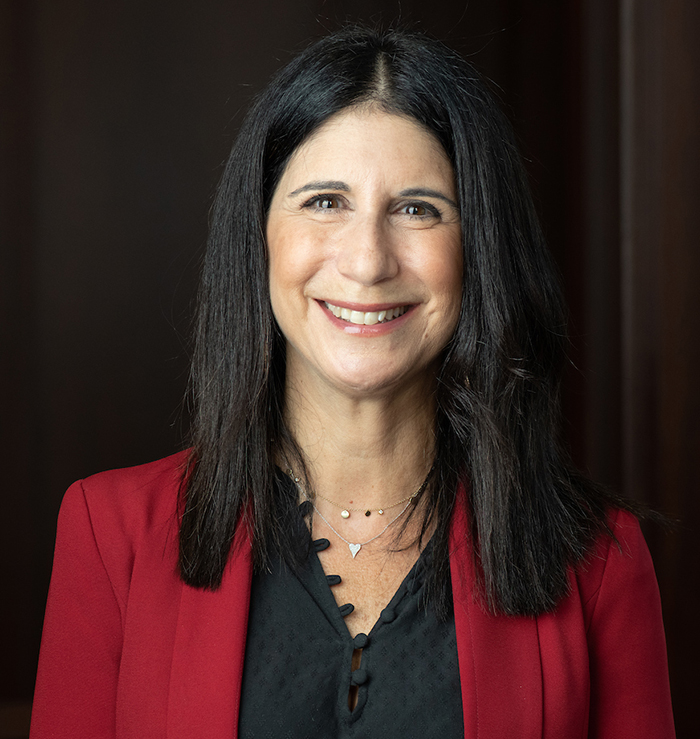
The University System of Maryland recognizes the Francis King Carey School of Law professor with its prestigious annual honor for excellence in public service.
Four faculty members from the University of Maryland, Baltimore (UMB) have been recognized with University System of Maryland (USM) Board of Regents Faculty Awards, the highest honor presented by the board to exemplary faculty members within the 12-institution USM. The UMB awardees are Eric Strauch, MD, School of Medicine; Sara Gold, JD, and Maxwell Stearns, JD, Francis King Carey School of Law; and Jay Unick, PhD, MSW, School of Social Work. (Additionally, two UMB employees were honored with Board of Regents Staff Awards.)
USM faculty members are honored annually for their excellence in one of five categories: Teaching; Scholarship or Research; Creative Activity; Public Service; or Mentoring. Each UMB winner is being profiled on “The Elm.”
Today: Sara Gold, JD, Clinical Law Instructor, Maryland Carey Law; Excellence in Public Service
About Professor Gold
Sara Gold is known for her innovative work providing legal services as part of health care and for fostering interdisciplinary collaborations to improve the health of Baltimoreans, receiving praise from clients, students, and collaborators from across disciplines as an outstanding public service leader.
She has demonstrated excellence in providing legal services to many low-income clients who would otherwise lack access to representation, and to training the next generation of lawyers to provide legal services to vulnerable clients throughout their careers.
Gold, who directs Maryland Carey Law’s Medical-Legal Partnership (MLP) Clinic, has long collaborated with clinics at the University of Maryland Medical Center to provide care to patients living with HIV. Her legal work aims to improve social determinants of health such as financial, family, and personal instability.
Gold has demonstrated profound commitment to providing high-quality legal services to individual clients through her client representation and supervision of law students; participating at community health events; and fostering relationships and serving as a legal resource for health care providers and social workers caring for patients across UMB and in the community.
Additionally, Gold trains social workers and providers to screen for health-harming legal needs and to refer patients to her legal clinic, and she has participated in several innovative collaborations to improve legal and health care to patients.
These include projects working with palliative care providers on medical decision-making and documenting preferences regarding end-of-life care; pharmacy and social work faculty to train providers to provide gender-affirming holistic case management to transgender patients through a UMB seed grant; and faculty from the Schools of Social Work, Medicine, Pharmacy, Dentistry, and Nursing in the Preparing the Future program to provide comprehensive care to people living with HIV.
Kudos from Colleagues
“Professor Gold is phenomenal. Since joining the Francis King Carey School of Law’s Clinical Law Program in 2011, she and her students have represented hundreds of clients in cases that impact clients’ overall physical and mental health and wellness.
“Professor Gold is a skilled lawyer, a caring and empathetic educator, and a selfless collaborator who has dedicated her career to working for the public’s interest. As one of her students wrote, ‘The world needs more people like you, especially right now. Thank you for showing me the lawyer I want to be and the power it can hold.’ ”
— Renée Laurent, JD, Dean and Professor, Maryland Carey Law
“Professor Gold has redefined the integration of legal advocacy within health care delivery. Through her leadership in developing and co-leading the Preparing the Future education program, she has trained hundreds of emerging public health professionals to understand and address the intersection of trauma-informed care and the social determinants of health.
“While these concepts are often viewed through a clinical lens, Professor Gold has innovatively extended this critical information to student lawyers, expanding the aperture in which future attorneys and policymakers view their clients and constituents. This work does more than inform — it also transforms. Students consistently report that these classes reshape their understanding of patient care, empowering them to recognize and respond to the structural barriers their clients face.”
— Abby Plusen, MSSW, Director of Education Programs, Institute of Human Virology, University of Maryland School of Medicine
“As a former student in her Medical-Legal Partnership Clinic, I can attest to the transformative impact Professor Gold has had on her students, clients, and the broader Maryland community. Through her innovative, compassionate, and client-centered approach to lawyering, she has undoubtedly set a high standard for public service in academia.
“Professor Gold encourages her students to view legal practice not only as a means for resolving disputes, but also as an indispensable tool in helping people navigate complex challenges and restore stability to their daily lives. Under her guidance, I learned that a lawyer’s duty to be a zealous advocate goes beyond offering legally sound counsel, encompassing also the need to empower and uplift clients.”
— Benjamin Link, JD, Maryland Carey Law Class of 2023
Professor Gold Says …
What was your reaction to winning the USM award?
“I was overwhelmed after reading the letters of support from a former student, former client, and interdisciplinary partners and colleagues, all of whom I have deeply valued as collaborative partners and without whom my Medical-Legal Partnership Clinic could not have served so many clients. To win the award is an incredibly meaningful recognition of the value of interprofessional partnerships to serve the legal and non-legal needs of vulnerable Baltimoreans.”
How does it feel to be selected among thousands of faculty members within USM?
“There are so many faculty members deserving of this award across many disciplines, which I know because I have the privilege of collaborating with many of them. I could not serve the clients and communities we serve without the support and partnership of other incredible faculty, providers, and staff from the Schools of Law, Nursing, Medicine, Social Work, Dentistry, and Pharmacy. I am incredibly humbled and honored to receive this award.”
What project, initiative, research, or accomplishment are you most proud of during your time at UMB?
“There are so many things, but if I had to pick one, I’d highlight a collaboration with faculty and students from law, social work, medicine, and nursing to help clients/patients document their wishes for life-sustaining treatment and medical decision-making, including during the COVID pandemic.
“In collaboration with faculty, medical and palliative care providers, nurses, and social workers, we’ve trained many students across the disciplines to counsel clients about the nuanced social, medical, emotional, relationship, legal, and financial issues surrounding medical decision-making and life-sustaining treatment choices.
“Interdisciplinary groups of students have conducted community education workshops and collaborated to counsel and prepare health care advance directives for clients, including conducting virtual workshops during the pandemic when there was a lot of uncertainty and fear around medical decision-making, death, and dying. Through this initiative, we’ve helped clients feel empowered and gain a sense of control over what is often an uncertain and scary time.”
What is your greatest asset in promoting and pursuing public service?
“I think my empathy for our clients who, without our representation, would likely have no access to legal care. I truly love working in a medical-legal partnership alongside health care providers and social workers to do our best to maximize clients’ mental and physical health and overall wellness.
“We recognize that many non-medical factors influence a person’s well-being — what we refer to as social determinants/drivers of health — and I am passionate about training students in this MLP model of care. I have also learned so much about the influence of trauma on our relationships with clients and am intentional about training the next generation of lawyers with the skills and passion to provide client-centered, trauma-informed legal services to vulnerable clients throughout their careers.”