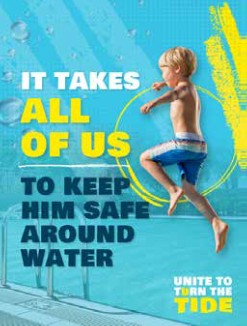
To be held July 25 this year, this day was created by the World Health Organization to bring attention to the global issue of drowning and ways that it can be prevented.
Every year, drowning takes more than 300,000 lives globally and is the leading cause of unintentional death in children between 1 and 4 years of age in the United States. It is the second-leading cause of unintentional injury death in children 5 to 14 and remains in the top five of unintentional death until age 55.
Drownings can occur at any location and even if adults and caregivers are present. The most dangerous locations do vary by age, where 87 percent of drowning fatalities of children younger than 5 happen in home pools. The second-leading locations can be bathtubs, ponds, wells, and even buckets. Believe it or not, more people in this world do not know how to swim than do.
Drowning risks also vary by race and household income. Black children ages 5 to 19 drown in swimming pools at rates 5.5 times higher than white children in the same age range. When parents or caregivers have no/low swimming skills, their children are more likely not to learn the skills needed for survival. This affects 78 percent of black children, 62 percent of Hispanic/Latino children, and 67 percent of white children.
These statistics are even scarier because drowning is 100 percent preventable. In 2021, the World Health Organization recognized the global issue and created a day to promote awareness: World Drowning Prevention Day, to be held this year on July 25. The goal is to reduce drowning by 35 percent by 2035.
This year, the theme is “Unite to Turn the Tide,” because it isn’t just one person’s responsibility, it is the entire community that you live in, the social groups that you take part in, local and national governments, and the good news is that it is never too late to start learning key interventions and even to start learning how to swim.
The No. 1 thing that parents/caregivers can do to start the process of protecting their children is by teaching them to never enter a body of water without asking for permission, even if it is to just get into a bathtub. It should be on the same level as telling your children not to touch the stove because it is hot or to put your seat belt on when you are in a car.
There are several activities for kids, articles for parents, and even apps that are offered to assist in spreading the word on how to be safe around all bodies of water.
Learning to swim can reduce the risk of drowning by 88 percent, and we are doing our part here at the University of Maryland, Baltimore (UMB). URecFit and the Wellness Summer U program participate in a six-week summer camp that provides water safety and swim lessons three times a week. Not only are participants learning the extremely important skill of how to swim, but they also receive water safety knowledge that they can take back to their families and friends. Many of the campers have participated in the program for several years, have moved through the swim levels, and are proficient swimmers in the pool.
If you are interested in learning more about water safety or what you can do to help spread the word about World Drowning Prevention Day, please feel free to reach out to Elizabeth Lasker, assistant director of aquatics, safety, and education at UMB, at elasker@umaryland.edu or by calling 410-350-5611.
Learn more about World Drowning Prevention Day.