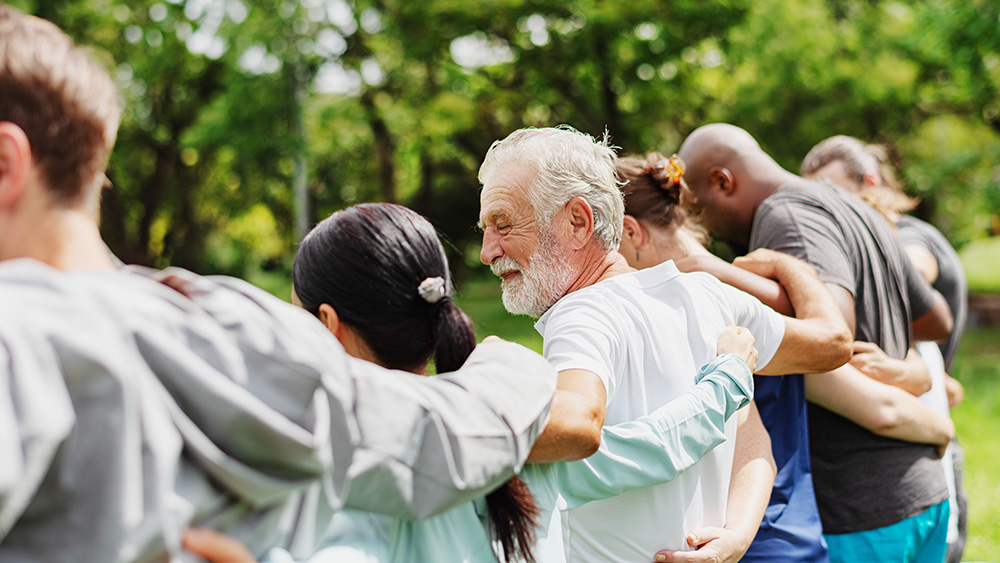
Some people believe resilience means facing life’s challenges alone. What if one effective way to manage stress is simply reaching out to another person? Part of the “Wellness Matters” blog series.
Many of us believe resilience means being able to handle life's challenges on our own. We admire self-sufficiency and praise independence. We tell ourselves things like, I've got this, I don't want to burden anyone, or I just need to push through.
But what if one of the biggest mistakes we make when we're stressed is trying to manage it alone?
Modern stress-management advice often focuses on what we can do for ourselves: exercise, meditation, breathing techniques, journaling, better sleep, and healthier habits. Don’t get me wrong: These strategies are valuable and should be part of our wellness routine. Yet, they are not sufficient. Neuroscience suggests that one of the most powerful regulators of stress is not something we do alone. It's another person.
Have you ever noticed how a problem can feel overwhelming when you're alone with it, but somehow more manageable after talking with someone you trust? Maybe you've called a friend after a difficult day and felt noticeably lighter afterward. Or perhaps you've walked into a room feeling anxious and found your body relaxing when a trusted person arrived.
What's remarkable is that the problem itself may not have changed at all. You may still have the same deadline, diagnosis, conflict, or uncertainty. But your nervous system has changed. The reason for this is not simply emotional; it’s biological.
We Evolved to Face Challenges Together
To understand why connection affects us so deeply, we need to understand the conditions under which the human brain evolved. For most of human history, survival depended on belonging to a group. Being separated from the group meant greater vulnerability to danger. Being connected increased the chances of survival.
As a result, the human nervous system evolved to associate connection with safety. Thousands of years later, our brains are still operating according to that blueprint. This means that feeling supported is not simply comforting. It is a biological signal that helps the nervous system relax. In other words, resilience is not purely individual, it’s also relational.
The Science of Connection
Researchers use the term co-regulation to describe the way nervous systems influence one another. You have likely witnessed co-regulation many times: a caregiver soothing a crying infant, a friend comforting another friend, a partner holding your hand during a difficult moment, or someone speaking calmly when you are upset.
In each of these situations, one person's regulated nervous system helps another person's nervous system settle. We are literally wired to borrow calm from one another.
One reason this happens is because supportive interactions trigger the release of oxytocin, sometimes called the bonding hormone. Oxytocin promotes trust, connection, and feelings of safety. It also helps reduce the body's stress response by lowering cortisol levels. In this way, connection doesn't simply feel good, it also changes our physiology.
Indeed, researchers have also found that the brain experiences stress differently when we feel supported. One of the most fascinating demonstrations of this comes from research conducted by psychologist James Coan and colleagues. In the study, women anticipated receiving a mild electric shock while their brain activity was monitored. When they faced the threat alone, brain regions associated with fear and vigilance became highly activated. But when they held the hand of a supportive spouse, activation in those threat-related brain regions decreased significantly.
Notice that the threat itself did not change. What changed was the brain's perception of the threat. When support is available, demands feel smaller, threats feel more manageable, and fewer internal resources are required.
The Great Irony of Stress
Given all of this, you might expect we would immediately seek support when feeling stressed. Some of us do, but many of us do the opposite. When we're overwhelmed, ashamed, grieving, exhausted, or struggling, many of us withdraw. We tell ourselves things like, I don’t want to burden anyone, nobody will understand, I should be able to handle this myself, or I’ll reach out when things settle down. Yet the moments when we feel most tempted to isolate are often the moments when connection would be most beneficial.
This is especially important because loneliness is not merely unpleasant. Research increasingly shows that loneliness affects both mental and physical health. The U.S. Surgeon General has identified loneliness as a significant public health concern, and chronic loneliness has been linked to depression, anxiety, cardiovascular disease, cognitive decline, and premature mortality. We have a biological need for connection.
What Support Actually Looks Like
When people hear the word support, they often think of advice, solutions, or problem-solving. But support does not always look like fixing. Sometimes support means being listened to. Sometimes it means feeling understood. Sometimes it means sharing a laugh, sitting quietly with someone, receiving a hug, or simply knowing that you do not have to carry a burden by yourself.
Indeed, one of the most important lessons from connection research is this: Support does not always remove the burden. Sometimes it simply helps us carry it. And often, that is enough to change our experience of stress.
Try It: The Connection Experiment
This week, reach out to one supportive person in your life. This might be a family member, friend, colleague, neighbor, or mentor. Before connecting, rate your stress on a scale from 0 to 10, where 0 represents no stress and 10 represents extreme stress.
Then connect. You might call them, meet for coffee, go for a walk, or have lunch together. Even a brief conversation may be enough to create a shift.
Afterward, notice the level of tension in your body, your mood, your breathing, your perspective on the situation, and your overall stress level. Then rate your stress again, using the same 0 to 10 scale.
Finally, ask yourself: Did the stressor change? Or did my experience of it change?
The Takeaway
We often think resilience is about becoming strong enough to handle everything ourselves. Science suggests something different. As humans, we are wired for connection. Support is not a luxury for us, nor is it a weakness. It is one of the ways our nervous systems were designed to function.
In a culture that celebrates independence, it is easy to forget that we are biologically designed to need one another. Sometimes one of the most effective stress-management strategies is not another technique. It's another person.
About the Author
Michelle Pearce, PhD, is professor and director of the Integrative Health and Wellness certificate program at the University of Maryland School of Graduate Studies.
Dr. Pearce is a clinical psychologist who researches the relationship between religion/spirituality, coping, and health, as well as the integration of spirituality into the practice of psychotherapy. Her areas of clinical expertise include cognitive behavioral therapy, mind-body stress reduction methods, existential issues, and behavioral medicine to address the intersection of mental and physical illness. Read her full biography.