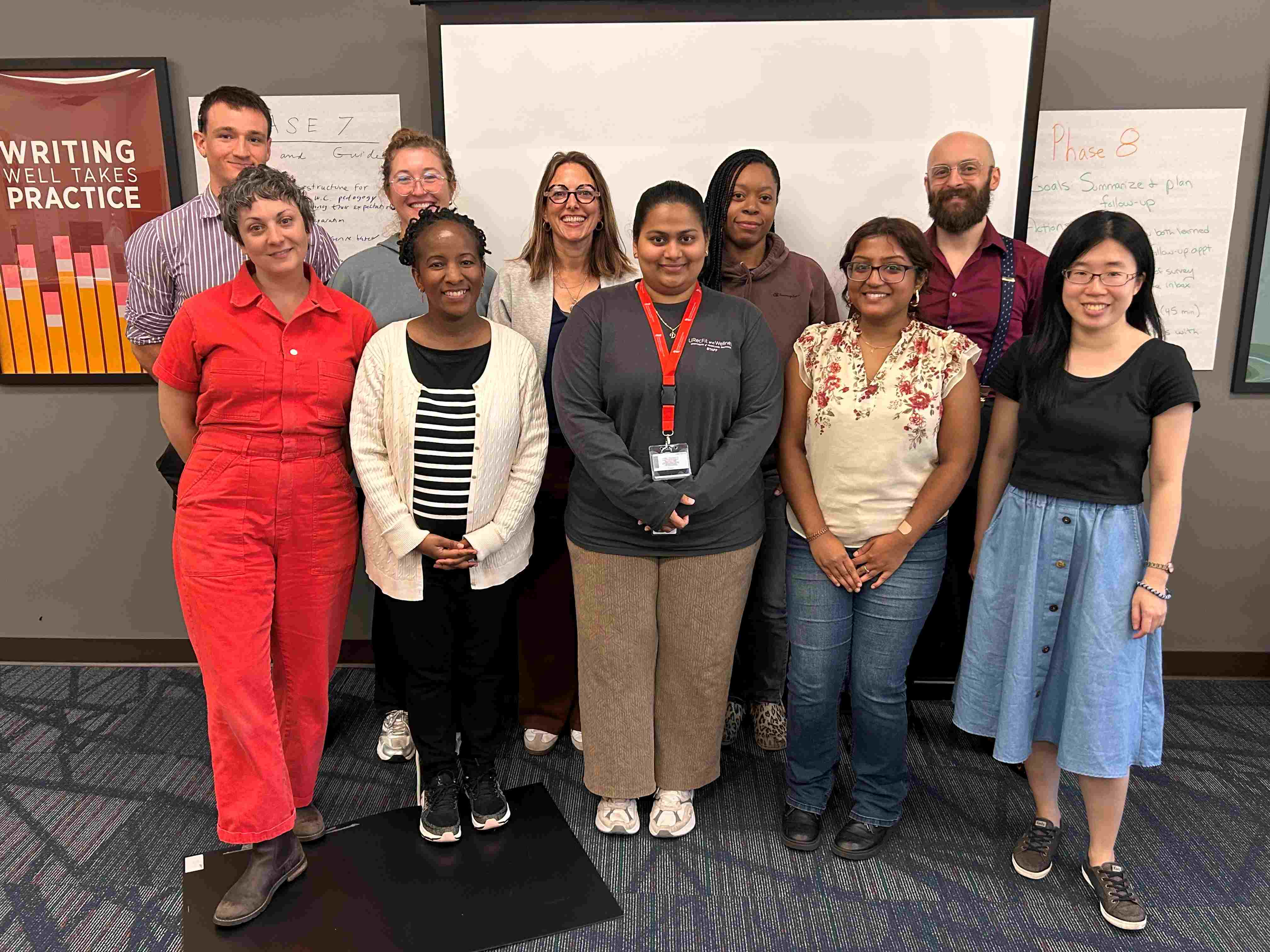
As fiscal and regulatory pressures transform higher education today, the UMB Writing Center continues to support UMB student writers.
“Higher education — you know, that’s us — we’re under attack.”
— UMB President Bruce E. Jarrell, MD, FACS
In his remarks at the fifth annual Faculty Convocation on Sept. 17, UMB President Bruce E. Jarrell, MD, FACS, noted the heavy fiscal and regulatory pressures UMB continues to face along with all higher education. He pointed out that the instigators of these pressures insist with “loud voices” that universities are no longer aligned with American values and so are incompatible with our country’s economic and political realities. President Jarrell has “got a beef” with this view of our university — and so does the UMB Writing Center.
As a campus hub for research and writing support, the center recognizes the incredible integrity, commitment, and skill of faculty who guide students through the challenging journey of creating, organizing, expressing, and applying disciplinary knowledge. We also collaborate every day with students determined to rise to the occasion as future scholars and practitioners preparing to lead their fields in solving complex 21st-century problems.
How Graduate Students Are Affected
The pressures to which President Jarrell alluded in his remarks continue to squeeze institutional resources, and our dedicated students bear the burden. For example, some students now grapple with the isolation, fear, and real material consequences of new visa and immigration rules. Many enrolled in public-service and lower-earning academic and professional programs must live with the threat that their programs will lose financial aid eligibility if graduates do not clear strict post-graduation income benchmarks.
These impositions and the current political climate around higher education can make the already demanding journey through graduate school even more challenging. Amid the uncertainty, UMB students expect a world-class education that prepares them to write as rhetorical strategists prepared to advocate for themselves and their communities, win competitive grants, critique and reshape policy, and draw on human nuance to lead research and clinical innovation.
How UMB Programs Prepare Graduate Student Writers
Despite these challenging circumstances, UMB programs and faculty across all seven schools continue to rise to the occasion. For example, programs in the Schools of Social Work and Law carry on long traditions of preparing graduate writers through organized writing-intensive curriculums. Others such as the interdisciplinary Graduate Program in Life Sciences and programs in the Schools of Pharmacy, Dentistry, and Nursing prepare students to become skilled scholarly, professional, and technical writers. In the School of Medicine, the Office of Student Research connects students with faculty mentors through research partnerships that expand students’ experience with literature evaluation, critical thinking, and research skills for clinical and academic careers.
These and other programs not only demystify writing conventions but train students as science communicators ready to translate health sciences and human services research for the broader public. For example, courses like Fundamentals of Public Health Practice in the School of Medicine’s Master of Public Health program and courses in the Science Communication Certificate program in the School of Graduate Studies immerse student writers in practices that seek to build trust with communities, correct misinformation, and improve outcomes.
The Role of the Writing Center
For over a decade, the UMB Writing Center has served as a partner in these exciting efforts. We align support with the actual experiences of graduate writers and with the demands of advanced disciplinary writing and clinical practice. Every year, hundreds of students from programs across the campus book consultation appointments with trained Writing Center fellows, themselves graduate students, to get individual attention to and feedback on their writing projects. When students gather with one another in the center, thinking and belonging emerge through the act of writing and through talking about writing with others.
This peer-to-peer model complements the relationship building and deep disciplinary learning that characterize faculty-student mentorship, a crucial pillar of graduate-level learning and major factor in the development of the professional identities of our students. At the same time, fellows and writers who work with them often study in different schools and programs and so meet from across academic traditions. Their work creates a distinctly interprofessional camaraderie rooted in shared student identity and experience. Their conversations make room to negotiate expertise, redefine authority, and deliberate choices for successfully writing themselves into ways of saying, knowing, doing, and being within and beyond singular disciplines.
Learning in the Writing Center does not stop here. As students of writing and writing education, fellows prepare for futures as informed communicators who will lead professional organizations, organize communities, and serve institutions as skilled researchers, writers, and writing teachers. Through our Writing Center training, fellows read and apply current theories and methods for peer-oriented writing support. They interact with and are mentored by some of the most prominent literacy and writing scholars, including Aja Martinez, Alexandria Lockett, and Sara P. Lopez Amezquita. Many fellows have conducted their own research on writing center practice and presented their findings at international, national, and regional professional conferences. Some have also served as student representatives on the executive board of the Mid-Atlantic Writing Centers Association.
Addressing the Challenges and Opportunities of AI
These dynamic learning experiences advance the University's strategic mission by providing equitable, inclusive, interdisciplinary, and evidence-based writing support. Yet we know that the “loud voices” to which President Jarrell referred might include those who champion an increasingly automated world dominated by generative artificial intelligence (GenAI), one that might cast these learning experiences and even the University’s mission itself as out of step with progress.
But these voices may be hard pressed to explain, for example, how GenAI could outperform the human-to-human connections forged in the Writing Center that promote student success, foster belonging, cultivate ethical and innovative communication practices, and strengthen collaborative learning across the institution and beyond. These voices might also struggle to sell the potential of GenAI when these outcomes characterize the very human qualities employers expect in job candidates. The issue is not about whether student writers can or should adopt technologies like GenAI into their professional repertoires but about how, when, to what extent, and why.
We realize that GenAI writing tools can instantly polish the grammar of a paper, but these same tools cannot think for students or replicate the dynamic relationships graduate writers build together to make meaning and solve the problems inherent in creating, organizing, expressing, and applying knowledge intended to improve the human condition.
Many students might rightfully be concerned that unstructured and expanding use of GenAI may derail their learning. Some might be moving away from a narrow focus on writing-as-product toward more realistic concerns about writing strategy and about the contexts that shape language choices in the first place. Perhaps ironically, these concerns may offer more, not less, attention to language choices within and across disciplinary and professional writing.
Working with the Writing Center
The Writing Center is here to continue engaging students and faculty in this thoughtful, necessary, and embodied work. We look forward to learning with you. To take advantage of our support programs, such as one-to-one writing consultation and the online writing accountability group, along with our print and digital writing resources libraries, visit our website or email us at writingcenter@umaryland.edu.