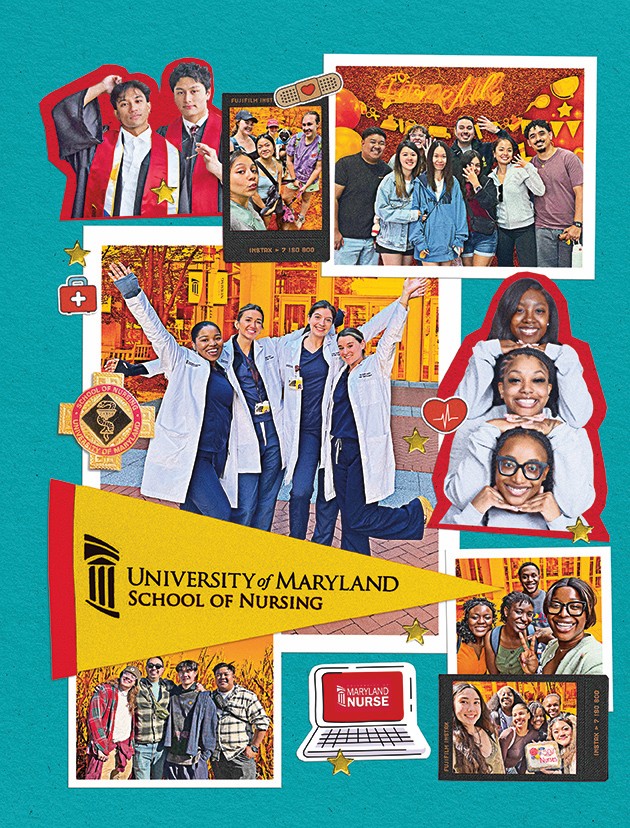
Creating a culture of belonging is a priority that UMSON and the University of Maryland, Baltimore share, and it has been a key focus of the University’s 2022 - 26 strategic plan.
“Nursing is built on human connections,” Yolanda Ogbolu, PhD ’11, MS ’05, BSN ’04, NNP, FNAP, FAAN, the Bill and Joanne Conway Dean says. “For our School, a strong sense of belonging fosters resilience, hope, collaboration, and well-being. As a profession grounded in caring relationships, nursing has both an opportunity and a responsibility to create environments where every learner and practitioner feels connected, valued, and empowered to succeed. I hope that all our students, faculty, staff, and alumni feel socially connected and develop strong relationships with peers, faculty, mentors, and communities so that they will know without a doubt they belong at UMSON today and in the future.”
Under Ogbolu’s leadership, the School has made significant efforts to foster an environment where students from all walks of life can flourish. “One of my favorite things to hear is that students feel like someone is really here to help,” says Sarauna Moore, MSW, LICSW, UMSON’s senior care and well-being specialist.
Students who feel welcomed and supported are better equipped to manage the School’s rigorous course load. “All the research out there tells us that higher belonging is associated with better mental health, better academic outcomes, and more persistence,” says Marisa Astiz-Martinez, DNP, MS ’13, RN, CNE, clinical instructor who serves as the faculty advisor for the University of Maryland Association of Nursing Students, the National Student Nurses Association chapter at the Universities at Shady Grove (USG) in Rockville, Maryland; she is also developing a peer support program for Bachelor of Science in Nursing (BSN) students.
“There’s a lot of data that shows that by joining organizations, students feel like they belong and can perform better. They’re able to be their authentic selves when engaging with faculty and staff,” says Yvette Conyers, DNP, RN, FNP-C, CTN-B, CFCN, CFCS, CNE, FADLN, CWCN-AP, FNAP, FAAN, assistant professor and associate dean for strategic engagement and inclusion.
Anuska Shrestha, a student in the BSN program, was applying to nursing school, she looked for institutions with a strong sense of community and culture, “and I found that at UMSON through its student organizations,” Shrestha says. I was graduating from Harford Community College [in Maryland], and I felt very supported on that campus. I liked that UMSON had the ongoing reputation of being a great school, and I saw throughout the website and the social media pages how there was a strong sense of community.”
That strong sense of community is not only a perception — it’s measurable. The School received high marks on the 2024 Leading Across Multidimensional Perspectives (LAMP) Culture and Climate Survey, developed by the American Association of the Colleges of Nursing (AACN). The survey included questions designed to assess a sense of belonging, focused on perceptions of connection or bonds with others as well as feelings of isolation or exclusion from the academic program or campus.
The LAMP survey results demonstrated a high sense of belonging among students across UMSON’s undergraduate and graduate programs: 89% of students in the undergraduate program reported they feel included when they interact with other people in their program, while 91% feel both welcomed and accepted within the program community. Graduate students expressed similar views, with 88% reporting they feel included when they interact with other people in their program; 88% of respondents said they feel welcomed within the graduate program, while 90% feel accepted within the program.
The School’s good vibes don’t happen by accident. “If you’re designing or in charge of running a nursing culture, you have to internally create a culture where belonging, community, and connection are a priority,” Astiz-Martinez says. “You can’t rely on it to happen organically. It involves cultivating relationships and having students engage in structured interactions over time.”