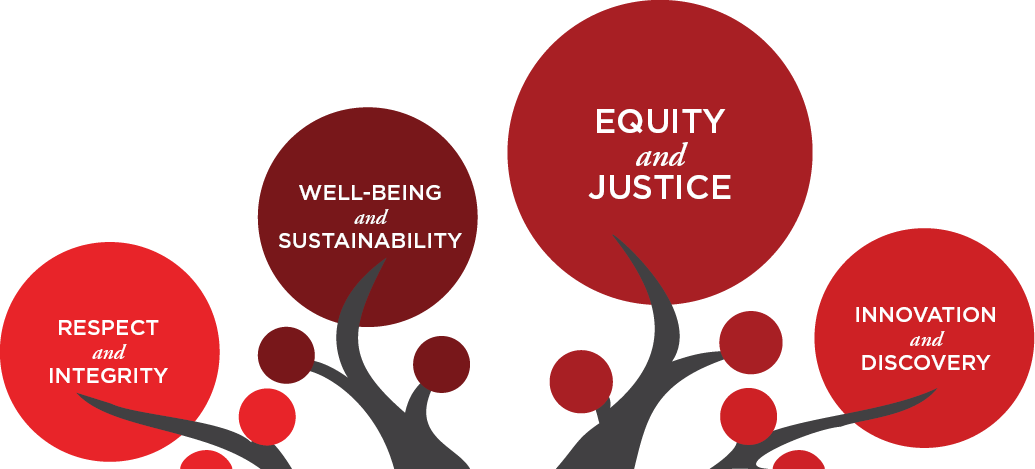
The past three months, we have focused on UMB’s core values set of Equity and Justice and our shared commitment to a fair, inclusive, and just community.
From February through April 2026, the University of Maryland, Baltimore (UMB) community engaged in a thoughtful and meaningful exploration of Equity and Justice, one of UMB’s core value sets that calls us to build inclusive and just communities where every person can contribute their talents toward our shared mission. Through speakers, shared reading, and Universitywide reflection, this focus invited us to consider how fairness, belonging, and opportunity are created not only through policies and systems, but also through our everyday choices and interactions.
Values in Action: Reflect First, Then Act
In collaboration with the Office of Values and Strategic Initiatives at the School of Graduate Studies, the Values in Action Speaker Series featured Rhea Roper Nedd, who encouraged the community to embrace the idea of Sankofa, reflecting on our past to create our future.
Her presentation challenged participants to pause before responding, to examine assumptions, and to thoughtfully consider how their actions impact others. By grounding action in reflection, Roper Nedd highlighted how individuals and institutions can make wiser, more equitable decisions that strengthen trust, accountability, and belonging across the UMB community.
Her message reminded us that justice is not only found in large-scale change efforts, but also in the daily moments when we choose curiosity over certainty, listening over defensiveness, and thoughtful action over reaction.
Roper Nedd was joined by our first student speaker, Imani Vice, a Class of 2026 Juris Doctor student at the University of Maryland Francis King Carey School of Law. She shared a powerful personal connection to the core value of Equity and Justice. Through honest reflection and thoughtful challenge, she encouraged participants to hold not only themselves, but also those around them, accountable to the standards of these values. Her remarks served as a meaningful reminder that advancing equity and justice requires collective responsibility and a shared commitment to rising to the challenge of improving the human condition.
We are excited to invite the UMB community to our next Values in Action Speaker Series event May 11, featuring Sol Roberts-Lieb, director of the Faculty Center for Teaching and Learning, and Erica Leyder, PhD candidate from the University of Maryland School of Medicine. This conversation will continue to explore how values are lived out in practice and how they shape our campus culture in meaningful ways. Register for the May 11 event.
UMB Reads!: Courageous Action and Equity
Equity and Justice were also explored through the UMB Reads! Book Club, where participants read "The Courage Gap: 5 Steps to Braver Action" by Margie Warrell, PhD.
Through engaging discussion, participants reflected on how courage is often required to speak up, challenge barriers, advocate for fairness, and take meaningful action even when doing so feels uncomfortable or uncertain. The book sparked important conversations about how each of us can develop our own courageous practices in service of a more equitable workplace and learning environment.
These discussions reinforced that Equity and Justice are not passive ideals — they are advanced through intentional choices, brave conversations, and a willingness to grow.
To find updates on upcoming readings and join future discussions, community members are encouraged to join the UMB Reads! Book Club Teams group.
Core Values Conversations: Small Actions, Meaningful Change
This season’s Core Values Conversation questions invited community members to reflect on what Equity and Justice look like in practice.
Participants were encouraged to consider what these values mean in the workplace, how fairness and inclusion are experienced in daily life, and where small changes could make a meaningful difference. Rather than focusing only on large institutional change, the questions invited people to notice the many ways each person can contribute — through listening, sharing opportunity, recognizing barriers, and helping create spaces where others feel valued and respected.
These reflections highlighted an important truth: Equity and Justice are often built through consistent everyday actions that, over time, shape stronger communities.
Community members who would like to continue responding to Equity and Justice conversation questions are invited to do so through the online form.
Looking Ahead: Shifting Our Focus to Innovation and Discovery
As we conclude this focus on Equity and Justice, we now turn our collective attention to the next core value set: Innovation and Discovery.
Innovation and Discovery ask us to consider not only what is possible today, but how curiosity, creativity, and new ways of thinking can help us better serve our communities tomorrow. They challenge us to examine existing systems, question assumptions, and explore opportunities to improve how we learn, work, teach, research, and care for others.
Just as Equity and Justice require reflection and action, Innovation and Discovery call us to imagination, collaboration, and the courage to try new approaches. We invite students, staff, faculty, and leaders across UMB to join the Core Values Conversations, events, and learning opportunities as we continue this work together, strengthening our community and advancing UMB’s mission of improving the human condition.
From now through the end of July, we will be highlighting UMB’s core value of Innovation and Discovery: We imagine and explore new and improved ways to accomplish our mission through education, research, clinical care, and service.
This is an opportunity to engage with this core value in an intentional way and share your insights with the UMB community.
Innovation and Discovery Question 1: Where in your daily work, learning, or service have you accepted “the way it has always been done,” and what new possibility might emerge if you questioned it?