Nine “Founding Pharmapreneurs” delivered groundbreaking advances in science, medicine, and innovation, solidifying the School of Pharmacy’s global reputation as a leader in the field.
This story is one in a series about the University of Maryland, Baltimore’s (UMB) contributions to U.S. history as the nation celebrates its 250th birthday this year. The stories will be featured on The Elm website/The Elm Weekly newsletter in the coming months. The series can be read at the UMB Celebrates America at 250 website. You can read previous stories about the School of Pharmacy’s history and collaboration with the FDA.
The United States is commemorating the 250th anniversary of the Declaration of Independence in 2026, but the celebration is about more than the founding of a nation. It also recognizes the people whose ideas transformed a young republic into a global leader in science, medicine, and innovation.
Few institutions embody that spirit more completely than the University of Maryland School of Pharmacy (UMSOP).
Founded in 1841 as the nation’s fourth-oldest school of pharmacy, the school was educating pharmacists at the very moment America was beginning its transformation from a collection of small apothecaries into the world’s pharmaceutical leader. For nearly two centuries, UMSOP’s graduates have not simply practiced pharmacy, they also have invented industries, launched companies, transformed patient care, expanded opportunities for women, pioneered ethical research, and created medicines that have improved the lives of millions.
Their stories span almost the entire history of the United States. Together, they tell the story of American entrepreneurship through the lens of pharmacy — a tradition the school proudly celebrates as “Pharmapreneurship.”
The tradition began with two young pharmacists in Baltimore.
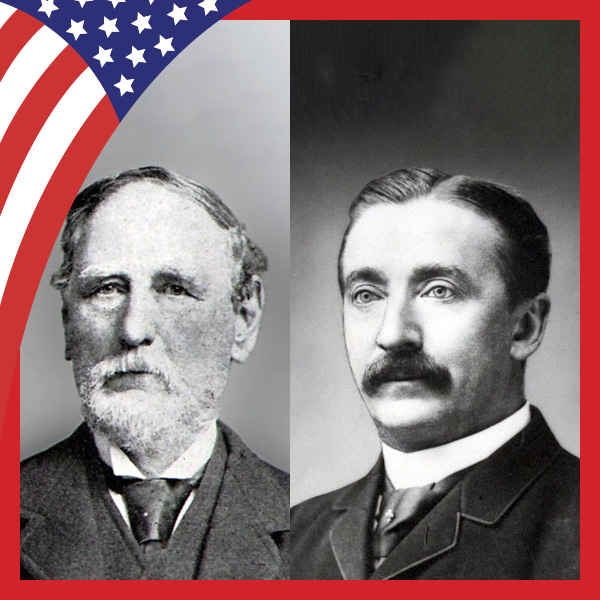
In 1842, Alpheus Sharp (at left in graphic above) graduated as one of only three members of the school’s first graduating class. After managing a neighborhood pharmacy, he hired a young German immigrant named Louis Dohme (at right in graphic) as his assistant and encouraged him to enroll in what was then the Maryland College of Pharmacy. Dohme graduated with honors in 1857, and four years later the two men founded the pharmaceutical company Sharp & Dohme.
Their timing could not have been better.
America was industrializing rapidly, and medicine was changing just as quickly. Rather than relying on inconsistent, hand-prepared remedies, physicians increasingly demanded pharmaceutical products manufactured to exacting standards. Sharp and Dohme built their company around purity, consistency, and scientific rigor, helping establish new expectations for quality in American medicine.
Over the following decades, the company expanded nationally, eventually becoming Merck, Sharp & Dohme —one of the world’s leading pharmaceutical companies today. Its Baltimore enterprise and UMSOP education helped lay the foundation for an industry that continues to drive medical innovation around the globe.
Only a generation later, another UMSOP graduate demonstrated that pharmaceutical innovation could begin behind the counter of a neighborhood drug store.
George Avery Bunting graduated as valedictorian in 1899 and purchased the pharmacy where he had worked as an errand boy. Experimenting after hours, he developed a greaseless sunburn cream packaged in a distinctive blue glass jar. He named it Noxzema, turning a local remedy into an internationally recognized consumer brand.
Under his family’s leadership, the company introduced CoverGirl Cosmetics, creating another iconic American brand with Baltimore and UMSOP roots. What began as one pharmacist’s curiosity grew into Noxell Corporation, illustrating how scientific knowledge, creativity, and entrepreneurial vision could reshape consumer health products for generations.
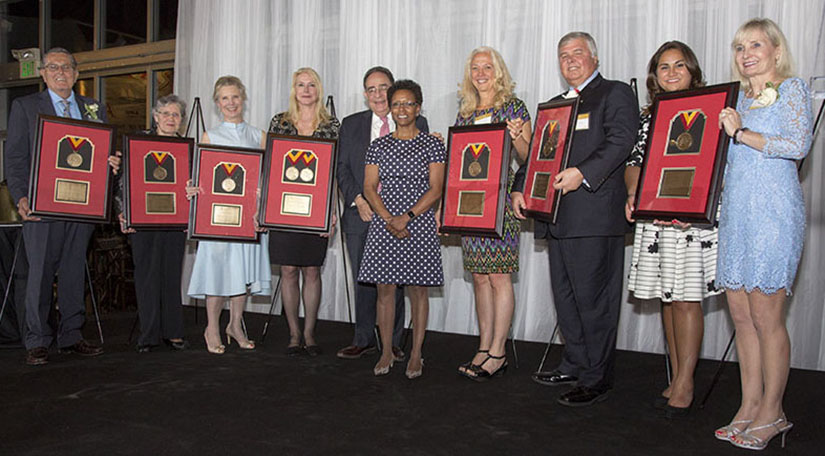
The School of Pharmacy honored its “Founding Pharmapreneurs” at a gala in May 2017. From left, Robert Henderson, Mary Catherine Bunting (representing her late grandfather George Avery Bunting), Ellen Yankellow, Sandra Milligan (representing Merck, Sharp & Dohme for Alpheus Sharp and Louis Dohme), then-UMB President Jay Perman, then-UMSOP Dean Natalie Eddington, Victoria Hale, John Gregory, and Rebecca Gyi-Hovis and Terry Gyi, the daughter and wife, respectively, of Felix Khin-Maung-Gyi. Calvin Knowlton could not attend but appeared via video (see below).
Building New Industries
As pharmacy evolved during the second half of the 20th century, UMSOP graduates continued to redefine what pharmacists could accomplish.
Robert W. Henderson, BSP ’63, combined pharmaceutical expertise with nutritional science to found Nutramax Laboratories. His patented glucosamine and chondroitin sulfate formulations created new categories of joint-health products for people and animals, while his research continued producing new nutraceutical innovations decades later.
Ellen H. Yankellow, BSP ’73, PharmD ’96, recognized that pharmacy could improve patient outcomes and simultaneously reduce health care costs. Through Correct Rx Pharmacy Services, she transformed institutional pharmacy by building a company centered on clinical services, medication management, and patient-centered care. Just as importantly, she became one of the profession’s most influential philanthropists and mentors, investing in future pharmacists through scholarships, fellowships, and experiential education.
John M. Gregory, BSP ’76, demonstrated how entrepreneurial vision could reshape pharmaceutical manufacturing. After opening a small-town pharmacy in Virginia, he founded multiple successful companies, including General Injectables and Vaccines and King Pharmaceuticals. Under his leadership, King Pharmaceuticals grew from a modest, family-owned business into a Fortune 500 company before its acquisition by Pfizer, creating thousands of jobs and expanding access to critical medicines.
Innovation also took forms beyond traditional drug development.
Felix A. Khin-Maung-Gyi, BSP ’83, PharmD, MBA, founded Chesapeake Research Review and became one of the nation’s foremost leaders in protecting human research participants. His work helped shape ethical oversight of clinical research and strengthened the systems that safeguard patients participating in scientific studies. His influence continues to be felt throughout biomedical research today.
Calvin Knowlton, PhD ’93, MDiv, saw an opportunity to improve health care through better medication management. Across 10 companies — including CareKinesis and Tabula Rasa Healthcare — he pioneered medication risk management and pharmacogenomics, demonstrating how pharmacy, technology, and data analytics could work together to improve care for older adults and medically complex patients.
Victoria Hale, BSP ’83, PhD, expanded the very definition of pharmaceutical entrepreneurship. Rather than measuring success solely through commercial markets, she founded the world’s first nonprofit pharmaceutical company, OneWorld Health, and later Medicines360, proving that innovative business models could make lifesaving medicines available to underserved populations worldwide. Her work earned international recognition — including the MacArthur “Genius” Fellowship — and demonstrated that entrepreneurship can be measured as much by lives improved as profits earned.
Finding Ways to Solve Problems
Although their careers unfolded across nearly two centuries, these nine innovators shared a common philosophy. They saw pharmacy not simply as a profession, but as a platform for solving problems. Some built global pharmaceutical companies. Others developed breakthrough products, advanced ethical research, transformed patient care, expanded educational opportunity, or reimagined how medicines could reach those who needed them most. Together, they illustrate the remarkable breadth of pharmacy’s impact on American life.
In 2017, UMSOP formally recognized these pioneers as its Founding Pharmapreneurs, honoring graduates whose entrepreneurial vision fundamentally changed pharmacy, health care, and society.
Their stories remind us that the nation’s progress has never depended solely on elected leaders or famous inventors. It also has been shaped by pharmacists working in laboratories, classrooms, community pharmacies, research organizations, manufacturing facilities, and startup companies — individuals who recognized unmet needs and had the courage to build something new.
From Baltimore storefronts to global pharmaceutical companies, from pioneering women in academia to nonprofit drug development, from ethical oversight of research to data-driven medication management, the school’s Founding Pharmapreneurs helped define what American innovation could become.
Their legacy continues today in every student who enters Pharmacy Hall believing that a pharmacist can do more than dispense medicine — that they can invent, lead, discover, build, and improve the health of the world.